





Your imagination decides what happens next.
Opening your library…
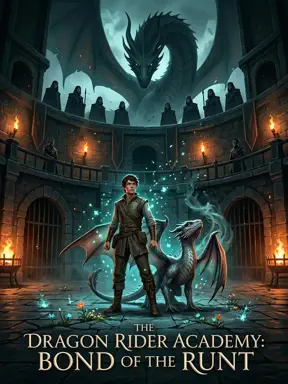
A runt marked for culling, and 30 turns to prove it was never scrap
This isn't a scripted demo. It's a 30-turn run of The Dragon Rider Academy: Bond of the Runt, played by the Loreon team on the current engine, with the event check switched on. Every action was typed freely; the narrator answered, and the chips under each scene are the state the game actually kept.
Turn 2 · The runt in stall nine
A snout noses through the gap, pale and crumpled as wet paper, then two bright eyes the colour of banked coals. One wing is shorter than the other, its membrane torn and stitched with clumsy black thread. It sniffs your fingers, and with its warm breath comes a drift of small white petals. Nobody has ever told you what a Scrap-Drake's breath does when it is pleased.
Turn 13 · A spark that mends
A pale bloom unfolds in the air between you and the cadet. The sparks from his rod catch on its petals and wink out, one after another, like candles pinched in a draught. The brass stake stops humming. Its tarnished green patina brightens to new copper for the length of a breath.
Turns 20–21 · The check that held
On turn 20 the archivist only says the word, and the narrator tries to mark the goal done. The check reads the prose, finds no answer in it, and holds the goal open. “A Hearth-Guardian is not a breed of weapon,” she says on turn 21. “The Academy’s Tether takes. A Heart-String only answers when it is asked.” Now the prose shows it, and the goal closes.
Turn 22 · Asked, not tethered
Clover, named on the Crucible sand seven turns earlier, steps between your knees and presses its forehead into your open palms. The warmth is not a spark’s heat but something softer, like sun on a stone wall at evening. Somewhere behind your ribs, something answers: a quiet, certain pull, not a chain but a door opening from the inside.
A narrator writes. An engine keeps the books.
Most AI story apps are one model and a chat log, so the world is whatever the model happens to remember. Loreon splits the job: the narrator writes the prose and marks every change it describes, and a game engine owns the state, checks each change against it, and hands the truth back before the next turn. Here is what happens between pressing Enter and reading the reply.
You act
Type anything or take a suggestion. The turn runs on the server, not in your tab: close it mid-sentence, open the story on your phone, and the same turn is still streaming there.
The narrator writes and marks
Alongside the prose it tags each change: an item taken, a goal closed, a place reached, a creature bound. You never see the tags, only their result.
Every paragraph is checked
Before it reaches you, each paragraph passes a content guard that rewrites or withholds what breaks the rules. A withheld paragraph changes nothing in your world: no phantom items.
The engine validates
A change that contradicts the record is rejected, and a malformed one is repaired. Then a second, independent model reads the finished turn and vetoes any change the prose does not actually show happening to you.
After the turn
Suggested choices, the scene’s illustration, a recap, level-ups and memory compression run in the background, so none of them delays the story. Reroll a turn and the whole world rewinds with it.
What the world keeps
Seven systems run under every story, plus growth and companions in stories built for them. The narrator reads their state on every turn, so the key you pocketed on turn 3 is still in your pocket on turn 50.
Map
Where you are, everywhere you've been, and places you've only heard named.
Inventory
Items enter and leave as the story shows them, each on a rarity ladder from common to legendary. Items can change, too, and come back as something new and rarer.
Goals
Objectives appear as the story reacts to you, and end completed, failed or open. Finished goals leave the narrator's view three turns after they close, so a 60-goal session still reads cleanly.
Growth
The engine owns every number. A deed is worth 1, 3 or 7 XP by weight, a finished goal 2, and no turn can earn more than 8. Each level offers three paths written from that world’s own rules. A “deed” that just restates a power you already hold earns nothing.
Time
The day moves on with your actions, so night falls, meals get missed and deadlines arrive.
Soundtrack
Each story has its own soundtrack, and the narrator switches cues as the scene turns: menace, triumph, the quiet of the stables.
Companions & creatures
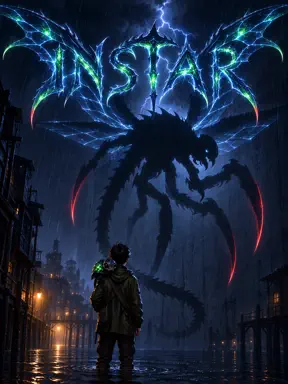
Whoever you bind joins a named ledger with a painted portrait. Instar's ledger holds 64 creatures and Gullet's 40, each name matched letter for letter in every language.
Illustration
Key moments are painted mid-story. A second model reads each paragraph as it streams and places the picture after the one it belongs to.
Endings
An open AI chat runs until you get bored. Every Loreon world is written toward real endings, and when you reach one, the story closes.
The 250th turn still remembers the first.
Long stories are where AI fiction usually falls apart: names drift, promises vanish, faces change. Loreon is measured on the long run. Play one forward and watch what it keeps.
Memory that holds at turn 258
Story memory grows ~650 tokens a turn. Once ~10,000 tokens have settled, a model rewrites them as a dense summary about a third the length; the most recent ~10,000 stay word for word.
The same face on turn 4 and turn 40
Every picture passes through two language models, a compositor and an image model. Before anything is drawn, the whole story is read.
It reads the whole story, every time
One call reads the canon, your entire narration history, the current beat and a catalog of every prior image. It pulls only what this moment needs to be drawn, each fact tagged with its source and linked to an image that already shows it.
It directs the shot like a cinematographer
Knowing the storyboard, the creature portraits, the backdrops and every picture from your run, it writes one short prompt: camera, frame, light, moment and consequence, each used only where the beat calls for it. Referenced subjects are named by image, never re-described.
Every reference, packed into one sheet
References are deduplicated, kept in the assembler’s order and laid into numbered sheets of up to 16 panels. Each “image 2” in the prompt is rewritten to its panel address, so the image model knows exactly whose face is whose.
It paints with them, then remembers
The render follows the references for identity and style. The finished picture is stored with its prompt and subjects, ready to be linked on later turns. Your run only references your run: pooling every player’s pictures let one popular look swamp everyone’s characters.
Every model choice is a measurement
Each model in Loreon has an offline benchmark that runs the real game code on real story contexts, judged blind by a panel of different models. Here is the one that mattered most, step by step.
Models write the story well. They keep the books badly.
Alongside the prose, the narrator records what changed. In real sessions it records things that never happened:
We counted it on 192 real changes
Every state change from sessions the system had never seen, checked one by one. Trusting the narrator alone, the world stayed correct 61.5% of the time.
A second model reads every turn
An independent model reads each finished turn and asks one question per change:
Not one true change blocked
The check only removes what the prose does not support. All 118 correct changes passed through untouched, and the whole check costs a fraction of a cent per turn.
Questions we stopped guessing
Each one was settled the same way: real story contexts, blind judges, a number. Here is what the benchmarks decided, and what they are testing next.
Should the narrator think before it writes? No. Thinking mode stays off.
Up to turn 100, six blind judges. Reasoning first scored no better, cost 1.3 s per turn, and did not improve coherence deep into stories.
Is there a better narrator than ours? Yes, so it replaced ours.
Side by side, judged blind. The newcomer led in all three repetitions and with three of four judges, and became the standard narrator in October 2026.
Will a name survive translation? Yes, with a naming style sheet.
Before a world is translated, each language gets its own naming style sheet and a glossary of up to 200 terms, so a character keeps one name.
The engine rolls the dice
In an earlier prototype, when the engine decided whether a risky move succeeded, the narrator honored 9 of 9 rolls, including 7 failures. Left to itself, it let 0 of 6 bold attempts simply fail.
Start with one of these
Five languages, five editions
English, Spanish, Portuguese, Ukrainian and Japanese. Each story is localized as its own edition — its world, names, title art and interface — rather than machine-translated on the fly.
Browse by genre
Coming from another app?
AI Dungeon alternative
Same freedom to type anything, inside a designed world with tracked state and real endings.
NovelAI alternative
A game you play, not a writing assistant you steer.
Character.AI alternative
A whole world with goals and an ending, not an open-ended chat.
Questions
Is Loreon free?
Free to start: begin as a guest, and signed-in readers can claim free actions every day. For more than the daily pace, there are subscriptions and one-time packs, and purchased packs never expire.
Do I need to download anything?
No. Loreon runs in the browser on phone, tablet and desktop. On Android you can also install it from Google Play.
Who is it for?
Readers 16 and up. Content policies govern what stories and the narrator may include, and you can delete your account and data at any time.
Your turn.
The lantern gutters. Somewhere beyond the fog a bell tolls, once, then twice. The story will not move until you do.
Interactive stories shaped by your decisions.